
AMarkets
AMarkets Review: An In-Depth Analysis of an Offshore Broker, Pitfalls, and Hidden Risks
AMarkets Review. In the world of online trading, few names evoke such polarizing opinions as AMarkets. Operating since 2007, the company has evolved from a local player under the brand Adrenalin Forex to an international company with thousands of clients worldwide. At first glance, it appears to be the ideal broker: modern platforms, leverage up to 1:3000, over 550 assets, and customer support.
However, behind the impressive figures and marketing slogans lies the harsh reality of “third-world” regulation. This Amarkets review aims not just to list features, but to thoroughly examine the company’s structure, reveal what offshore registration truly means for your wallet, and explain why a $5,000 bonus could turn into a financial trap.
If you are looking for an honest analysis without promotional promises, you’ve found it. We will cover everything: from the legal status and trading platforms to the mechanics of the affiliate program and real user reviews, leaving out the marketing noise.
AMarkets Review. Regulation and Legal Status: The Illusion of Security
Where is the Company Actually Registered?
Perhaps the most crucial point of any Amarkets review is answering the question: “Who controls the broker?”. The truth is that AMarkets is not a single corporation but a network of several legal entities registered in jurisdictions with extremely liberal tax and regulatory climates.
According to official data, the group uses three main registrations:
- AMARKETS LTD – Registered in the Comoros Islands (Mwali International Services Authority license № T2023284).
- AMARKETS LLC – Registered in the Cook Islands (Number LLC14486/2023, FSC register).
- AMARKETS LTD – Registered in St. Vincent and the Grenadines (Number 22567 IBC 2015, FSA register).
What Does Offshore Registration Mean for the Client?
To the uninitiated, the words “regulated by the FSA” sound solid. But in the world of finance, not all regulators are created equal.
- The Case of St. Vincent and the Grenadines (SVG FSA): This is not a financial services regulator in the classical sense at all. In St. Vincent, you register companies, but you don’t license brokerage activities. The FSA SVG does not require compliance with capital adequacy norms (as required by the FCA or CySEC), does not conduct inspections, and does not protect investor rights. It is essentially a “mailbox” service. Having a registration there provides clients with absolutely no guarantees whatsoever.
- The Case of the Comoros Islands (MISA): This is also an offshore zone. The MISA regulator issues licenses, but the level of supervision and fund protection is minimal and incomparable to European MiFID II standards.
- The Cook Islands: This jurisdiction is known more for offshore banking and trust registration than for strict forex broker regulation.
The Financial Commission: Marketing Ploy or Real Protection?
In an attempt to add credibility, AMarkets joins self-regulatory organizations. The company is a member of The Financial Commission, an independent body that resolves disputes between traders and brokers.
- The Plus: The Commission is willing to compensate a client up to €20,000 if a dispute is resolved in their favor. This creates an illusion of a safety net.
- The Minus: This is not deposit insurance. The Financial Commission’s compensation fund is formed from contributions from the brokers themselves. It is not an independent guarantor like the British FSCS, which protects client funds even in the event of a broker’s bankruptcy. The decisions of this commission are advisory in nature, and €20,000 is a drop in the bucket if the broker faces serious financial difficulties.
Section Summary: When dealing with AMarkets, you must understand that your funds are not protected by a government insurance system (like in banks) or a reputable mega-regulator (FCA, CySEC, BaFin). You are relying solely on the company’s integrity and financial stability. Having “regulation” from MISA or the FSA SVG is a registration, not a license that offers real guarantees.
AMarkets Review. Registration and Getting Started: Fast and Simple
Account Opening Procedure
From a technical standpoint, the registration process with AMarkets is simple and an industry standard.
Registration requires minimal information:
- First and Last Name
- Email Address
- Mobile Phone Number
Important Note: At the registration stage, you are not asked for passport details or your country of residence. This is done to increase conversion (fewer fields = more registrations). However, it’s too early to relax. The most difficult part—verification—awaits you later, usually upon your first attempt to withdraw funds.
Verification (KYC): No Right to Anonymity
Although the broker’s website states that phone confirmation is not mandatory at the start, the “Know Your Customer” (KYC) policy applies to everyone without exception. To withdraw funds, you will need to provide scans of your passport (or other ID) and possibly proof of residence (a utility bill or bank statement).
AMarkets has the right to request additional documents, and withdrawal of funds will be blocked until the verification is complete. This is a standard global practice aimed at combating money laundering, but it often unnerves beginners.
AMarkets Review. Trading Platforms and Instruments
MetaTrader 4 and MetaTrader 5: Stable Classics
In terms of software, AMarkets doesn’t reinvent the wheel and offers the industry standard—the MetaTrader 4 (MT4) and MetaTrader 5 (MT5) platforms.
MT4/MT5 are available on all devices:
- Desktop: Windows, Mac.
- Web: Web terminals for trading through a browser without installing software.
- Mobile: Apps for Android and iOS.
Proprietary Developments and Analytics
AMarkets tries to add value with its own tools. For example, the “Trade Analyzer” service tracks the dynamics of profitability, drawdowns, and strategy effectiveness. Popular third-party services like Autochartist for technical analysis are also available.
- The Minus: All these “features” are supplementary. The main trading is still done through MT4/MT5, which any reputable broker offers. AMarkets doesn’t have a unique “killer feature” here.
AMarkets Review. Affiliate Program: How the “Kitchen” Works Inside
The AMarkets affiliate program deserves special attention. The broker places a huge emphasis on it, and for many, an Amarkets review begins with evaluating the affiliate program.
Terms for Webmasters
AMarkets offers two main cooperation models, typical for the market:
- CPA (Cost Per Action): The partner receives a fixed payout for each referred client who makes a deposit (usually $100 or more).
- Revenue Share (RevShare): The partner receives a percentage of the spread or commission generated by the referred client (usually 20-40%).
Hidden Risks for Clients Coming Through Affiliate Links
High affiliate commissions and aggressive marketing are always a “red flag” for a client. The more a broker pays to acquire a client (CPA), the higher the cost of that client for them. To recoup this money and turn a profit, the broker needs the trader to either lose their deposit (if it’s a “bucket shop” model) or generate a very high trading volume (which is more important for the broker, as they earn commissions on volume).
Many partners use aggressive strategies, promising clients the “moon and the stars.” As a result, the client arrives with inflated expectations and is often disappointed by the realities of trading. This is the broker’s fault, a direct consequence of its marketing policy.
AMarkets Review. Bonuses and Promotions: Analyzing the Terms (The Fine Print)
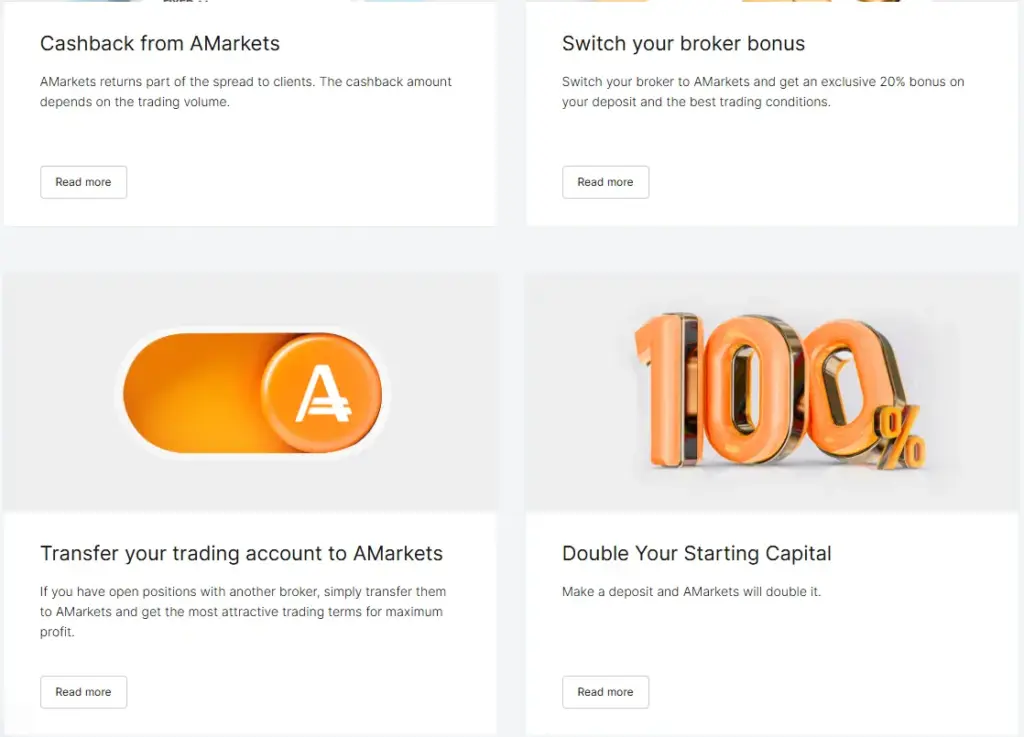
Bonuses are the most dangerous and ambiguous aspect of dealing with any forex broker, and AMarkets is no exception. The company offers welcome deposit bonuses (up to 100% or more), credit bonuses, cashback, and loyalty programs.
To understand the true face of the broker, you need to read the Bonus Terms and Conditions. This is the document that every client signs when agreeing to a bonus.
How Bonuses are Credited
The most popular type is the “Trading Bonus.” For example, you fund your account with $1000, and they credit you with a $150 bonus. This $150 appears in the “Credit” line in your MetaTrader terminal.
Key Point: This $150 is not your money. You cannot simply withdraw it.
Conditions for Withdrawal (Bonus and Profit)
This is where it gets interesting and complicated. Bonuses are divided into categories, and the rules for unlocking them vary.
A) Trading Bonus (Participates in Drawdown)
This bonus acts as a “safety cushion” (leverage), but it is extremely insidious.
- Participation in Drawdown: The bonus is the first to be burned if you start losing money. If your balance (your own funds) drops and your Equity becomes less than the credit (bonus) amount, the bonus is written off. In effect, the bonus insures the broker, not you.
- Withdrawing Profit: You can withdraw profit, but with caveats. If, after withdrawing profit, the bonus’s share of the funds in the account exceeds 20%, the bonus will be partially or completely written off.
B) Credit Bonus (Requires Trading Lots)
These are bonuses from promotions like “Double Your Starting Capital.” The rules here are stricter. To turn the bonus into real money and withdraw it, you need to trade a huge number of lots.
- Formula: Required Turnover (lots) = Bonus Amount / 3.
- Example: You receive a $100 bonus. To withdraw it, you must trade 33.3 lots (100/3) on currency pairs alone. Moreover, each trade must be at least 3 pips. For a small deposit of $100, trading 33 lots is a nearly impossible task that forces the trader to take enormous risks.
Company’s Discretionary Powers
The most alarming section of any terms and conditions is the company’s rights. The AMarkets terms contain clauses that give the company virtually unlimited power over bonus funds:
- “The Company may make changes to the Bonus Promotion Rules without prior notice to Clients.”
- “The Company has the right to disqualify Participants of the Bonus Promotion without giving a reason.”
- “The Company may terminate the Bonus Promotion without giving a reason.”
If the company suspects a client of abuse (e.g., using “arbitrage” or “risk-free” strategies to unlock the bonus), it has the right to write off the bonuses and even block the account.
Section Summary: AMarkets bonuses are not a gift but a marketing tool strictly tied to trading conditions. They increase the risk of losing your own funds due to misunderstanding the mechanics of credit write-offs and impose extremely burdensome turnover requirements.
AMarkets Review. Analysis of Reviews: Between Euphoria and Disappointment
For an objective Amarkets review, it’s necessary to examine what real users are saying. The picture is highly contradictory.
Negative Reviews and Client Problems
It’s important to understand the nature of these complaints.
Main Cons in the Eyes of Clients:
- Verification on Withdrawal: The classic situation – everything is fine until you try to withdraw. As soon as you request a significant sum, requests for additional documents and checks begin. Although this is a legal requirement (AML), clients often perceive it as an attempt to delay payment.
- Spreads and Commissions: Some users complain that spreads (especially on Standard accounts) widen during news events, leading to stop-losses being hit. On ECN and Zero accounts, there is a commission ($2.5 per lot and up), which increases the cost of trading.
- Bonus Traps: The most scathing reviews are related to misunderstandings of the bonus rules. Traders take a bonus, trade successfully, make a profit, and then when trying to withdraw, they find the bonus is written off or the terms have changed. Reading the fine print (described above) usually clarifies things, but the bitter taste remains.
Analysis of Neutral Reviews
Many experienced traders view AMarkets as a “workhorse”—not the cheapest, but reliable in terms of payouts. Cons mentioned include the lack of advanced analytics for professionals and a limited set of hedging instruments (e.g., no direct options or futures trading).
AMarkets Review. Disadvantages of Working with AMarkets: The Final Verdict
Summarizing all of the above, we can highlight the objective disadvantages and risks that must be considered when deciding whether to cooperate.
AMarkets Review. Regulatory Vulnerability
This is the biggest drawback, outweighing many of the pros. The jurisdictions of St. Vincent and the Comoros Islands do not provide investor protection. In case of force majeure (bankruptcy, license revocation, fraud), clients will be left to fend for themselves. Suing a company based in the Comoros Islands is a futile endeavor.
AMarkets Review. Aggressive Bonus Policy
Bonuses are imposed on the client on extremely unfavorable terms. They are not only “not a gift” but also complicate capital management:
- They create confusion between own funds and credit funds.
- They can be written off unilaterally.
- They require unrealistic trading turnover for withdrawal (e.g., a $100 bonus = 33 lots).
AMarkets Review. Commissions and Fees
Although the advertising talks about no hidden commissions, they exist:
- Withdrawal Fee: The broker charges a fee for withdrawing funds. Partners can withdraw without fees, but regular clients pay.
- Swaps: The standard fee for holding a position overnight. Islamic accounts are available for Muslim-majority countries, but for others, this is a cost.
AMarkets Review. Need for High Financial Literacy
AMarkets is not suitable for beginners who are lured by ads featuring 1:3000 leverage and bonuses. The broker provides a tool but does not protect against foolishness. High leverage in skilled hands is a tool; in a beginner’s hands, it’s a guarantee of quickly losing their deposit. The company does not conduct “strict” moderation of strategies (except those it deems fraudulent), and a client can blow their deposit in minutes.
AMarkets Review. Geopolitical and Country-Specific Risks
AMarkets, having Russian roots (founded in the Russian Federation in 2007), came under sanctions pressure and was forced to relocate. The company clearly limits cooperation with clients from a number of countries (including the UK, USA, Canada, Japan, and even Israel and Egypt). This creates uncertainty for residents of “borderline” jurisdictions.
Who is AMarkets Categorically NOT Suitable For?
- Beginners: The risk of losing money due to a lack of understanding of margin trading and bonus mechanics is too high.
- Conservative Investors: If you are looking for capital preservation and bank-level reliability, this is not your choice.
- Security-Paranoid Individuals: Those who need to know their money is held in a bank under the supervision of the ECB or FCA should steer clear of offshore brokers.
AMarkets Review. Conclusion
AMarkets is a typical representative of the “offshore” brokerage business that has managed to survive. Its strengths are its long history, variety of accounts, modern platforms, and a functional affiliate program. Its weaknesses are its “paper” regulation in offshore zones and an aggressive, confusing bonus policy that can backfire on the trader themselves.
However, from a security perspective, this is a choice of dubious reliability. Essentially, you are lending money to the broker based on its word alone. In a world where brokers with FCA (UK) or CySEC (Cyprus) licenses exist—offering perhaps lower leverage but segregation of funds at the European legislative level and access to compensation funds—choosing AMarkets should be a conscious decision based solely on the need for specific trading conditions, not on faith in the “international regulation” of the Comoros Islands.
We hope this Amarkets review has helped you form an objective opinion about this broker and make an informed decision.
Check out broker ratings and reviews on this page. Also read articles in the news section.
More information about Forex broker affiliate programs is available on the website.
Please sign in to your account to leave a review