
Grand Capital
Grand Capital Review: A Detailed Analysis of Offshore Regulation, Bonus Structures, and Real Client Experiences
Grand Capital Review. The world of online trading in the Forex and CFD market is vast and diverse, offering opportunities that attract millions of retail traders globally. Among the multitude of brokers available is Grand Capital.
For any potential investor, the most crucial step before depositing funds is to conduct a thorough and unbiased analysis. The purpose of this article is to provide precisely that: a comprehensive examination of Grand Capital. We will leave no stone unturned, scrutinizing its regulatory status, the implications of offshore licensing, the real cost of attractive bonuses, and the collective user sentiment expressed in online reviews. Our goal is to equip you with all the necessary information to make an informed decision.
The Allure and Risks of Online Trading
The foreign exchange market, with a daily turnover exceeding $7.5 trillion, is the largest financial market in the world. Its 24-hour operation, high liquidity, and potential for profitability make it an attractive arena for individuals seeking financial independence. Online brokers like Grand Capital act as intermediaries, providing the platforms, tools, and access needed to participate.
Grand Capital positions itself as an established broker. The company may seem like a safe harbor. The website looks professional, the platforms are the industry-standard MetaTrader 4 and 5, and the promises of bonuses and high leverage appear enticing.
But beneath the surface of any trading site lies a fundamental question of trust. How is the company regulated? Who oversees its activities? What happens in the event of a dispute? These questions are not merely theoretical; they are the bedrock upon which the security of client funds is built. In this review, we will be guided by these questions, starting with the most critical aspect: regulation.
Grand Capital Review. Regulatory Framework Overview: The Foundation of Trust
Regulation is the single most important factor when choosing a broker. A reputable regulator, such as the UK’s Financial Conduct Authority (FCA), the US Commodity Futures Trading Commission (CFTC), or the Cyprus Securities and Exchange Commission (CySEC), imposes strict rules on brokers. These include capital adequacy requirements, segregation of client funds (keeping client money separate from the company’s funds), negative balance protection, and access to independent dispute resolution and compensation schemes.
The information regarding Grand Capital’s regulatory status, as presented on its official website and other sources, paints a less reassuring picture.
The International Services Authority (MISA) License: What It Really Means
As stated on their regulations page, in 2024, Grand Capital announced obtaining a license from the Mwali International Services Authority (MISA, Union of Comoros). The Comoros Islands are a small island nation off the coast of East Africa. Their status as an offshore financial center is well-known in the industry, and a license from MISA is often referred to as an “offshore license.”
What does this license actually entail?
or a broker, obtaining a license from an authority like MISA is significantly easier and cheaper than securing one from a top-tier regulator like the FCA. Capital adequacy requirements are minimal, oversight is far less stringent, and regulatory enforcement is often opaque or non-existent. While the Grand Capital website states the license entitles them to provide financial services, manage assets, and offer brokerage services, it is vital to understand that this is permission to operate, not a guarantee of safety.
For the client, trading under such an offshore license means the following:
Limited Recourse
If a dispute arises that the broker is unwilling to resolve, your options for legal recourse are severely limited. You would be subject to the laws of the Union of Comoros, a jurisdiction you likely have no connection with and whose legal system is not designed to protect international retail Forex traders.
Absence of a Compensation Scheme
Unlike brokers regulated by the FCA and covered by the Financial Services Compensation Scheme (FSCS), which can protect deposits up to £85,000, the Comoros has no such government-backed system. Your funds are not insured.
Minimal Oversight
- The likelihood of MISA conducting regular and rigorous audits of Grand Capital’s financial practices, client fund segregation, or operational procedures is very low.
In essence, the MISA license provides a veneer of regulatory legitimacy but offers no real investor protection. It allows the broker to operate internationally while bypassing the costly and complex compliance requirements of major financial centers.
FinaCom Membership: An Alternative to Regulation?
Grand Capital actively advertises its membership status with The Financial Commission (FinaCom) and its reliability rating. It is crucial to understand what this is and, more importantly, what it is not.
The Financial Commission (FinaCom) is an independent, industry-backed external dispute resolution (EDR) service. It is not a government regulator. Brokers pay for membership, and in return, their clients gain access to a dispute resolution process.
However, this is not a substitute for stringent regulatory oversight.
Self-Regulatory Organization
FinaCom is funded by its members (the brokers). This creates an inherent conflict of interest.
Limited Scope
The Compensation Fund is a limited pool of money. In the event of a major broker’s insolvency, the €20,000 limit per client is a fraction of what a government program might offer, and there’s no guarantee the fund could cover all claims simultaneously.
Lack of Enforcement Power
FinaCom can rule in a client’s favor, but its power to compel a broker to pay is limited to expulsion from the organization. A broker could simply ignore the ruling.
Therefore, while FinaCom membership provides a modest layer of recourse, it supplements rather than replaces stringent regulatory oversight.
The decision to obtain a MISA license in 2024, while maintaining FinaCom membership, suggests a strategic positioning: maintaining a presence in industry self-regulatory bodies while formally basing operations in a minimally intrusive jurisdiction.
Grand Capital Review. Account Types, Trading Conditions, and Platforms
Grand Capital offers a variety of account types designed to appeal to traders of different experience levels and capital sizes. This is a common strategy to attract a broad audience.
Diversity of Account Types: From Cent to Professional
The account options offered have a tiered structure, with spreads, commissions, and minimum deposits varying accordingly.
- Cent Account
- Standard Account
- Swap-Free Account
- Professional Account
- Cryptocurrency Account
Given the offshore regulation, the maximum leverage is typically very high (up to 1:1000), which significantly amplifies risk.
Trading Platforms: MetaTrader 4, MetaTrader 5, and Proprietary Offerings
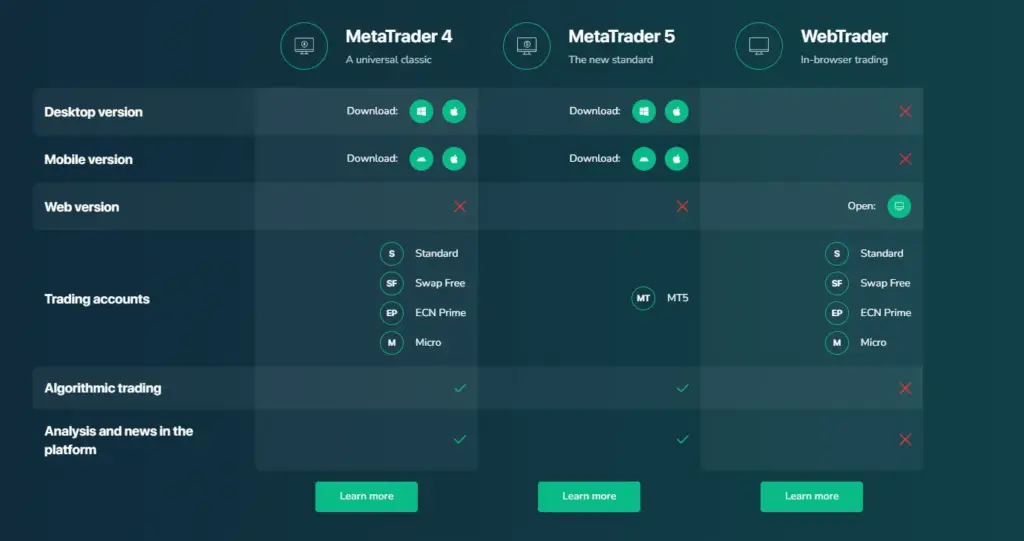
Grand Capital offers the ubiquitous MetaTrader 4 (MT4) and its successor, MetaTrader 5 (MT5). These platforms are renowned for their stability, advanced charting tools, automated trading capabilities (Expert Advisors or EAs), and strong community support. Traders can use a platform they are already familiar with and have access to a vast ecosystem of indicators and scripts.
They also promote their own proprietary app, GC Trader, likely aiming to reduce dependency on MetaQuotes, the developer of MetaTrader.
Tradable Instruments: An Overview of the Asset Library
Grand Capital offers a selection of over 200 trading instruments, including:
- Forex: Major, minor, and exotic currency pairs.
- Commodities: Gold, silver, oil, and agricultural products.
- Indices: Major global indices like the S&P 500, FTSE 100, and DAX.
- Stocks: CFDs on shares of major companies like Apple, Google, and Tesla.
- Cryptocurrencies: A selection of popular cryptocurrencies against the US Dollar and other currencies.
Grand Capital Review. Critical Analysis of Bonuses
Bonuses are one of the most powerful marketing tools for Forex brokers. Grand Capital, like many others in the offshore space, uses them aggressively. The allure of offers like “get a 100% deposit bonus” or “$30 no-deposit bonus” is potent, especially for novice traders with small capital. However, these bonuses are rarely free money. They come with terms and conditions that are critical to understand before accepting an offer.
The Anatomy of a Bonus: Common Types Offered by Grand Capital
- Welcome/Deposit Bonuses: A percentage of your deposit is credited as bonus funds (e.g., 30%, 50%, or even 100%). If you deposit $1000 with a 50% bonus, you get an extra $500 in bonus money, giving you $1500 to trade with.
- No-Deposit Bonuses: A small sum of money, perhaps $30-$50, is credited to your account just for signing up and verifying.
- Loyalty/Rebate Bonuses: Returning a portion of trading costs or compensating for trading volume.
Unpacking the Terms: Deposit, Turnover, and Time Requirements
The true nature of a bonus is revealed in its terms and conditions. The key conditions to look for are the turnover requirement (also called volume requirement) and the expiry date.
Let’s dissect a typical 50% deposit bonus from a broker like Grand Capital.
- The Offer: You deposit $500 and receive a $250 bonus. Your trading balance is $750.
- The Requirement: The terms state that to withdraw the bonus and any profits made from it, you must trade a certain number of lots. Often, this is expressed as a multiplier (e.g., “40x”). But 40x what? This is where the complexity begins.
- This is 40 times the bonus amount ($250 x 40 = $10,000 required turnover).
- This is 40 times the deposit + bonus ($750 x 40 = $30,000 required turnover).
- This is tied to the initial deposit or other factors.
- Time Limit: You will only have 30 or 60 days to meet this trading volume requirement. Failure to meet this requirement will result in the bonus and any profits generated from it being removed from your account.
For a retail trader with a $500 account, trading $10,000 to $30,000 in a month is a monumental task. It forces the trader to take excessive risk, trading high volume and low margin just to meet the requirement, often leading to significant losses.
Grand Capital Review. Real-World Scenarios: The Reality of the Bonus Program?
Consider two scenarios:
The Cautious Trader
A trader accepts the bonus but continues trading cautiously. They make a steady 10% profit over a month ($75 on the $750 balance). The trading volume is only $5,000, which is half the required amount. They cannot withdraw their profit. The bonus and the $75 profit are locked until the volume target is met. If they hit a losing streak afterward, they could lose the profit and part of their initial deposit.
The Aggressive Trader
A trader accepts the bonus and immediately starts trading large volumes to meet the requirement. This often involves taking position sizes larger than their risk management would normally allow. A few bad trades could wipe out a significant portion of their account.
Bonuses are a tool designed to encourage traders to deposit more money and make more trades. Bonus terms are intentionally set to make it difficult to withdraw the bonus and associated profits.
Summary of Online Reviews
Online reviews provide an unfiltered view of client experiences. For Grand Capital, as with most brokers, the picture is mixed.
Negative Reviews: Withdrawal Issues, Slippage, and Bonus Complaints
Negative reviews are more concerning and tend to cluster around specific, critical points:
Withdrawal Delays and Denials
This is the most common and serious complaint. Clients report that account replenishments are instantaneous, while withdrawal requests are delayed for several days or even weeks. Some claim withdrawals are denied for technical reasons such as insufficient trading volume, verification issues not previously mentioned, or repeated requests for additional documentation.
Slippage and Requotes
Several reviews mention excessive slippage during news events or volatile market conditions, where orders are filled at a price significantly different from the requested one. Some also report frequent requotes, which can be detrimental to scalping strategies.
Bonus “Scams”
A significant number of negative reviews come from traders who accepted bonuses and then found themselves unable to withdraw funds. They claim the turnover requirements were applied unfairly, or that their trading style (e.g., hedging) was suddenly prohibited while using bonus funds, leading to the loss of their deposit.
Account Freezing
In rarer cases, users report their accounts being frozen without a coherent explanation, with customer support either non-responsive or providing evasive answers.
Analysis of Review Sources
Specialized Forums (e.g., Russian, Indian, Indonesian): Since Grand Capital operates in these regions, forums in local languages often contain the most detailed and culturally relevant feedback. They can be a treasure trove of information on region-specific issues, such as problems with local payment systems.
Grand Capital Review. Deposits and Withdrawals
The ability to deposit and, more importantly, withdraw money from your trading account is the ultimate test of a broker’s integrity.
Payment Methods and Currency Options
Grand Capital supports a range of payment methods:
- Bank Cards: Visa and Mastercard.
- E-wallets: Skrill, Neteller, Perfect Money, Advcash, and others.
- Cryptocurrencies: Bitcoin, Tether (USDT), and other major cryptocurrencies.
- Local Payment Solutions: Depending on your region, options like India’s UPI, Vietnamese banking systems, or local Indonesian transfers may be available.
- Bank Wire Transfers.
Accounts can be opened in several base currencies, including USD, EUR, and even RUB and Gold, helping clients avoid constant conversion fees.
The Withdrawal Process: Rules and Fees
The greatest difficulties often arise in the withdrawal process. According to the website information and user reviews:
- Verification: Before the first withdrawal, you must undergo full verification (uploading ID and proof of address). This is a standard KYC procedure.
- Method: Withdrawals are typically processed back to the source funding method wherever possible. For instance, if you deposited via Visa, the withdrawal will likely go back to the same card.
- Fees: The broker may state they do not charge withdrawal fees, but payment systems or intermediary banks often do.
Grand Capital Review. Systematic Client Complaints Regarding Withdrawals
Excessive Delays. Grand Capital Review
he stated “1-3 business days” for processing drags into 5, 10, or more days, with customer support offering vague excuses like “technical issues” or “high volume of requests.”
Repeated Verification Requests. Grand Capital Review
Some users report being asked to re-submit verification documents after submitting a withdrawal request, even if they were already verified. This appears as a tactic to stall the process.
Withdrawal Cancellation. Grand Capital Review
Often, withdrawals are marked as “canceled,” or the funds are returned to the trading account, with the broker citing unmet bonus conditions or other vague reasons.
Account Audits. Grand Capital Review
A common tactic to delay withdrawals, especially for profitable traders, is to initiate an “audit” or “compliance check” of the account, which can take weeks.
Such practices create a significant barrier between the trader and their own money, a hallmark of a broker facing liquidity issues or one that is simply not client-oriented.
Grand Capital Review. Educational and Analytical Resources
Grand Capital provides a standard set of educational and analytical materials:
- Grand Magazine: A collection of articles on trading strategies, market analysis, and broker news.
- Webinars and Seminars: Often pre-recorded or covering recurring basic topics.
- Economic Calendar: A standard tool for tracking important market events.
- Market Analysis: Daily analytical forecasts, often generic in nature.
One should not expect profound value from these resources; they serve primarily as marketing content.
Customer Support. Grand Capital Review
Grand Capital offers customer support via several channels:
- Live Chat: Available on the website.
- Email: Designated email addresses for general and financial inquiries.
- Phone: Local and international phone numbers.
- Messengers: Support via Telegram and other messaging apps, which is common for brokers targeting specific regions.
Support Quality and Accessibility
The quality of support reported in reviews is highly inconsistent. For simple pre-sales questions, the live chat may be responsive. However, when it comes to complex financial issues, particularly withdrawal problems, the support experience often deteriorates sharply. Responses become generic, slow, or evasive. The presence of phone support is positive, but its effectiveness is questionable if the staff lacks the authority or information to resolve serious disputes.
Grand Capital Review. Is Grand Capital the Right Broker for You?
After a thorough examination of Grand Capital, from its regulatory framework to client feedback, a complex picture emerges. The broker embodies the risks inherent in trading with an offshore entity.
Grand Capital Review. Key Risks:
Offshore Regulation (MISA)
The primary license is from a jurisdiction with minimal oversight, offering very weak investor protection.
Aggressive Bonus Schemes
Bonuses come with onerous turnover requirements that can trap client funds and incentivize risky trading.
Persistent Withdrawal Complaints
- A recurring theme in online reviews is the difficulty, delays, and denials associated with processing withdrawal requests.
Lack of Top-Tier Regulation
Absence of oversight from a major financial authority like the FCA or CySEC.
Variable Customer Support Quality
Support can be unhelpful or evasive when resolving complex financial disputes.
High Leverage Risk
Leverage up to 1:3000 can rapidly amplify losses.
Grand Capital Review. The Verdict
Grand Capital is best described as a high-risk, offshore broker operating in the grey area of the financial world. The business model is built on the foundation of lenient offshore regulation, which inherently favors the broker in any dispute.
The purpose of this Grand Capital review is to provide an unvarnished truth, allowing you to weigh the attractive features against the significant risks. The most prudent advice for any trader is to always independently verify the regulatory status, read the terms and conditions of any promotion meticulously, and never invest money you cannot afford to lose. In the world of offshore Forex, due diligence is not just a recommendation; it is your only real protection.
Check out broker ratings and reviews on this page. Also read articles in the news section.
More information about Forex broker affiliate programs is available on the website.
Please sign in to your account to leave a review